Tiếng Việt
Automated Warehouse Knowledge
What is a Pallet Shuttle Warehouse? A Breakthrough High Density Storage Solution for the Modern Logistics Industry

In the context of increasingly fierce competition and increasing requirements for optimizing storage space, the Pallet Shuttle Warehouse system has become one of the advanced solutions, helping businesses improve operational efficiency, minimize costs and maximize storage density. With high automation capabilities, this system is suitable for application in diverse warehouse environments such as cold storage, fast-moving consumer warehouses or factory warehouses. This is a breakthrough in logistics technology, contributing to promoting the development of the logistics industry in an optimal, flexible and sustainable direction.
Pallet Shuttle warehouses not only bring space benefits but also open up many new opportunities for smart warehouse management and operation. In this article, we will delve into the outstanding aspects of the system, from basic concepts, technical structures, operating procedures to advantages, disadvantages and practical applications in different fields. In particular, we will comprehensively analyze the development of automated warehouse systems, thereby helping businesses better understand the trends and investment opportunities suitable for their fields.
General introduction to Pallet Shuttle Warehouse system
The Pallet Shuttle Warehouse System is a warehouse automation solution that maximizes high-density storage in limited space. Developed based on modern technology, this system uses shuttle vehicles running along rails on storage shelves to import, export and unload pallets automatically and accurately. As a result, businesses can minimize time and labor during operation, while improving business efficiency.
During the development process, this system has proven its high applicability in many fields, from fast-moving consumer goods warehouses, cold storage, to large manufacturing plants and distribution centers. The highlight of Pallet Shuttle Warehouse is its flexible operation, suitable for warehouses with compact size but still need maximum storage density. The quality and reliability of this system are increasingly improved, suitable to meet the increasing demands of the modern logistics industry.
The Pallet Shuttle Warehouse System is also a symbol of the trend of automated warehouses – contributing to promoting the digital transformation process in warehouse management, helping businesses maintain sustainable competitiveness in the global market. Below are detailed contents about the concept, development history and common applications of this system.
What is a Pallet Shuttle System?

The Pallet Shuttle system is an automated storage solution in which shuttle vehicles run along rails on pallet racks to autonomously perform import, export, and pallet stacking operations. The distinguishing feature of this system compared to traditional warehouses is the ability to operate automatically, minimizing human intervention, thereby improving productivity and accuracy in goods management.
The shuttle vehicles in this system are capable of moving along the length of the shelves, helping to optimize storage space and shorten the time it takes to process goods. What is special is that they can operate in FIFO (first-in, first-out) or LIFO (last-in, first-out) modes, suitable for each industry’s requirements or the specific management process of the business. In practice, this system is often combined with automatic warehouse management software, creating an almost completely autonomous, error-free and fast operating process.
With the development trend of technology this time, Pallet Shuttle Warehouse becomes an alternative solution to traditional warehouses, especially suitable for limited spaces, requiring high storage density and fast processing time. The practical benefits brought to businesses are undeniable, and more and more units have begun to switch to this model to improve competitiveness.
Popular applications in logistics and warehousing
The Pallet Shuttle system is constantly expanding its scope of application and clearly demonstrating its superiority in many different fields. In the logistics industry, especially large distribution centers and warehouses, this system helps to handle large quantities of goods in a short time, ensuring delivery progress and minimizing unnecessary inventory.
In addition, in cold storage or special storage, the Pallet Shuttle system helps maintain stable temperature, minimizing the risk of loss due to manual operations. Manufacturing plants, especially in the pharmaceutical, food, or electronics industries, also apply this system to ensure quality control and traceability of goods accurately and quickly.
This system is also suitable for small and medium-sized businesses that want to switch to an automated warehouse process, saving space while still ensuring flexibility in control and operation. Thanks to its flexible integration capabilities, Pallet Shuttle Warehouse has become a popular solution in diverse industries, from supermarkets, factories to multinational distribution centers, contributing to accelerating the digital transformation process in warehouse management.
Outstanding benefits of applying this system
In today’s competitive global environment, optimizing every aspect of warehouse operations is key to improving a company’s competitiveness. The Pallet Shuttle Warehouse System not only helps increase storage density and reduce costs, but also brings many other practical benefits such as: reducing labor, improving accuracy, reducing processing time, and increasing scalability.
One of the big pluses of this system is its ability to operate continuously, without depending much on skilled personnel or the weather. In particular, it helps businesses manage inventory accurately, knowing the quantity of goods at each batch, thereby easily planning for storage, inventory and appropriate distribution. The high level of automation also minimizes the risk of errors due to manual errors.
In addition, using Pallet Shuttle Warehouse also helps businesses save significantly on long-term operating costs, because it reduces labor costs, energy consumption and system maintenance. The flexibility of the system allows businesses to easily expand or adjust the warehouse model according to development needs without much difficulty, in line with the current rapid development trend of the logistics industry.
Features and specifications of Pallet Shuttle Warehouse
The modern Pallet Shuttle system integrates many advanced technologies to ensure smooth, safe and highly efficient operation. The technical features of the system are constantly improved to meet the increasing requirements of the warehousing and logistics industry. In addition, the system structure is scientifically designed, flexible, easy to operate as well as maintain and upgrade.
In this section, we will look at the design structure, automatic guidance technology, suitable pallet types, operating functions and FIFO, LIFO operating modes to give you a comprehensive view of the technology of this system.
System structure and main components
The Pallet Shuttle Warehouse System is structured with many main components, which work together to form an optimal automatic operating process. These components need to ensure continuous, accurate and safe operation, suitable for diverse warehouse environments.
The shelf frame is the main part of the system, responsible for supporting, storing goods and creating specialized shelf lanes for shuttle vehicles to move. Common types of shelves include double deep shelves, selective shelves or multi-level shelves depending on storage requirements and types of goods. The common features of all these types of shelves are high load capacity, easy-to-assemble design, suitable for automatic systems.
Shuttle Robots and equipment clusters such as safety sensors, guide wheels, and drive wheels act as “powerful assistants” during operation. These robots are equipped with laser sensors and long-range sensors to accurately guide along the rail, avoid collisions, and optimize the movement process. The central control software helps automate all operations from pallet arrangement, shipping to final distribution.
Navigation and automatic control technology
Guidance technology is the heart of modern Pallet Shuttle Warehouse systems . Shuttles typically use laser guidance, optical sensors, or software-based automated guidance systems over Wi-Fi or Ethernet networks. Laser sensors help pinpoint the shuttle’s position relative to the rails and other warehouse components, ensuring collision-free travel and optimized routing.
In addition, the central automatic control system continuously updates data on the location and operating status of each shuttle, helping to optimize schedules and reduce waiting times. Operators can monitor all processes via the remote control interface, as well as execute manual commands when necessary. This technology also integrates route optimization algorithms, helping to save energy and improve operational efficiency.
The application of this automatic guidance technology not only improves efficiency but also minimizes safety risks, reduces the number of operating staff, and is suitable for the development of intelligent, fully automated warehouses.
Suitable pallet types for use
Choosing the right type of pallet is a decisive factor in the efficiency of the Pallet Shuttle Warehouse system . In fact, popular types of pallets are all designed to work optimally with this system, including plastic pallets, wooden pallets and steel pallets. Each type has its own advantages and disadvantages, suitable for each type of goods and warehouse environment.
Plastic pallets are a popular choice because of their high durability, good load-bearing capacity, easy cleaning and reuse many times. Usually made from recycled or new plastic, plastic pallets are suitable for industries that require cleanliness such as food, pharmaceuticals, electronics. Wooden pallets have the advantage of being sturdy, cheaper, suitable for heavy goods or goods that do not require high hygiene. Meanwhile, steel pallets are often used in heavy industries, goods with large loads, requiring high durability and safety in transportation.
Choosing the right pallet will help the system operate at maximum efficiency, while minimizing loss and damage during transportation and storage.
Operating functions: automatic loading, unloading, and consolidation
The TQG Pallet Shuttle Warehouse System has many comprehensive automatic operating functions, helping to maximize productivity and accuracy in handling goods. These include key activities such as stacking pallets on shelves, unloading goods from shelves, and bundling goods to optimize space. These functions can operate simultaneously or in separate processes depending on the requirements of the business.
The automatic stacking function is performed by shuttle robots, moving along the rails, lifting pallets to the appropriate position in the shelves. The unloading function allows pallets to be removed from the shelves, quickly, accurately and safely. In particular, the consolidation function helps to minimize empty space in the warehouse, very suitable for the management process according to FIFO or LIFO mode.
These functions are all controlled by central software, which is capable of flexible programming to suit each type of item and specific operating requirements of each business in the modern logistics industry.
FIFO and LIFO operating modes

In warehouse management, choosing the right operating mode has a big impact on the efficiency of storage and distribution of goods. The flexible Pallet Shuttle system supports two main modes: FIFO (First-In, First-Out) and LIFO (Last-In, First-Out).
FIFO is suitable for items that require quality control, shelf life, or compliance with standard distribution procedures. When operating under FIFO, the first pallets are taken out first, ensuring that inventory is always fresh, hygienic, and in compliance with quality control regulations.
In contrast, LIFO is often used in warehouses that do not require age control, such as steel warehouses, construction material warehouses, or items that can be stored for a long time without spoiling. In LIFO, the newest pallets are taken out first, which helps maximize warehouse space and minimize handling time.
Both modes are integrated in the central control software, allowing businesses to easily and flexibly switch to suit each stage, product type and distribution strategy.
Operating procedure of Pallet Shuttle system
The Pallet Shuttle Warehouse System operates according to a strict and precise process to ensure maximum efficiency, minimize operating errors and improve productivity. This process starts from receiving goods, arranging, transporting, storing to final distribution, all of which are coordinated by automatic equipment in a coherent and unified manner.
Through clear steps, businesses can easily understand and control the entire warehouse operation process, while optimizing space and time for handling goods. Let’s go into each specific step of this process.
Receiving and arranging pallets by forklift
Automated Trucks
Automated Trucks
Reach Truck
Reach Truck 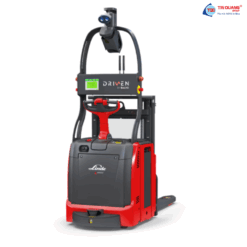
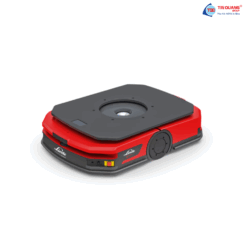


The process begins when pallets of goods are brought into the warehouse, usually via forklifts or autonomous robots to move the goods to their initial placement locations. This process requires a high level of precision to ensure that the goods are placed in the correct location, in accordance with the requirements of the Pallet Shuttle system .
After the pallets are placed at the top positions of each lane in the racking system, the forklift will move the goods to the correct designated position based on the data of the management software. This arrangement ensures that the goods are in the right flow, convenient for the automatic operation process later.
During this stage, checking and confirming the quantity and status of the goods is also very important to avoid errors, loss or damage during processing.
Shuttle process moving in the shelf
Once the pallets are placed, the shuttle begins its work in the racking lane. Depending on the requirements, the shuttle can move in FIFO or LIFO mode to process new outbound or backorders.
During this process, laser sensors and distance sensors work continuously to provide precise guidance, avoid collisions and ensure the safety of equipment and goods. The shuttle will automatically move along the rails, lift or lower the pallet to the appropriate storage position or pick up the goods to move out of the warehouse.
This process is seamless, minimizing waiting time and manual errors. The system also allows for the operation of multiple shuttles simultaneously, maximizing processing speed.
Manage and optimize storage space
One of the great benefits of Pallet Shuttle Warehouse is the ability to manage and optimize space very effectively. In fact, this system helps to arrange pallets scientifically, continuously updating the location and status of goods in the central software.
Through automatic pallet consolidation, the system helps to minimize empty space in the warehouse, increasing storage density to the highest possible level. Route optimization algorithms and automatic scheduling help to minimize unnecessary searching and moving time, thereby improving the speed of goods processing.
In addition, the system also provides reports and data analysis so that businesses can monitor warehouse status, inventory reserves and plan imports and exports more flexibly and accurately.
Distribution and shipping on demand
When there is a request to export goods, the necessary pallets will be located by the system and retrieved according to FIFO or LIFO mode. The shuttle vehicles will adjust their positions, lift the goods off the shelves and move them to the pre-programmed unloading point. The entire process is automatic and accurate, ensuring progress and service quality.
In addition, the system also integrates the ability to distribute according to flexible delivery orders, meeting sudden needs or according to predetermined schedules. Thereby, businesses reduce waiting time, improve transportation productivity and deliver on time.
Integrate automatic warehouse management software
Warehouse management software plays a central role in coordinating the entire operation of the Pallet Shuttle system . Data on pallet location, goods status, import-export schedules, and inventory are all updated in real-time, helping businesses monitor and adjust flexibly.
In addition, the software also supports optimizing operating routes, automatically allocating resources, scheduling picking and warehousing in accordance with actual capacity. This helps minimize time waste, maximize productivity and system capacity.
This management system also integrates with ERP software and CRM systems to create a comprehensive, modern management ecosystem, helping businesses manage their warehouses intelligently and effectively.
Structure and main components of the system
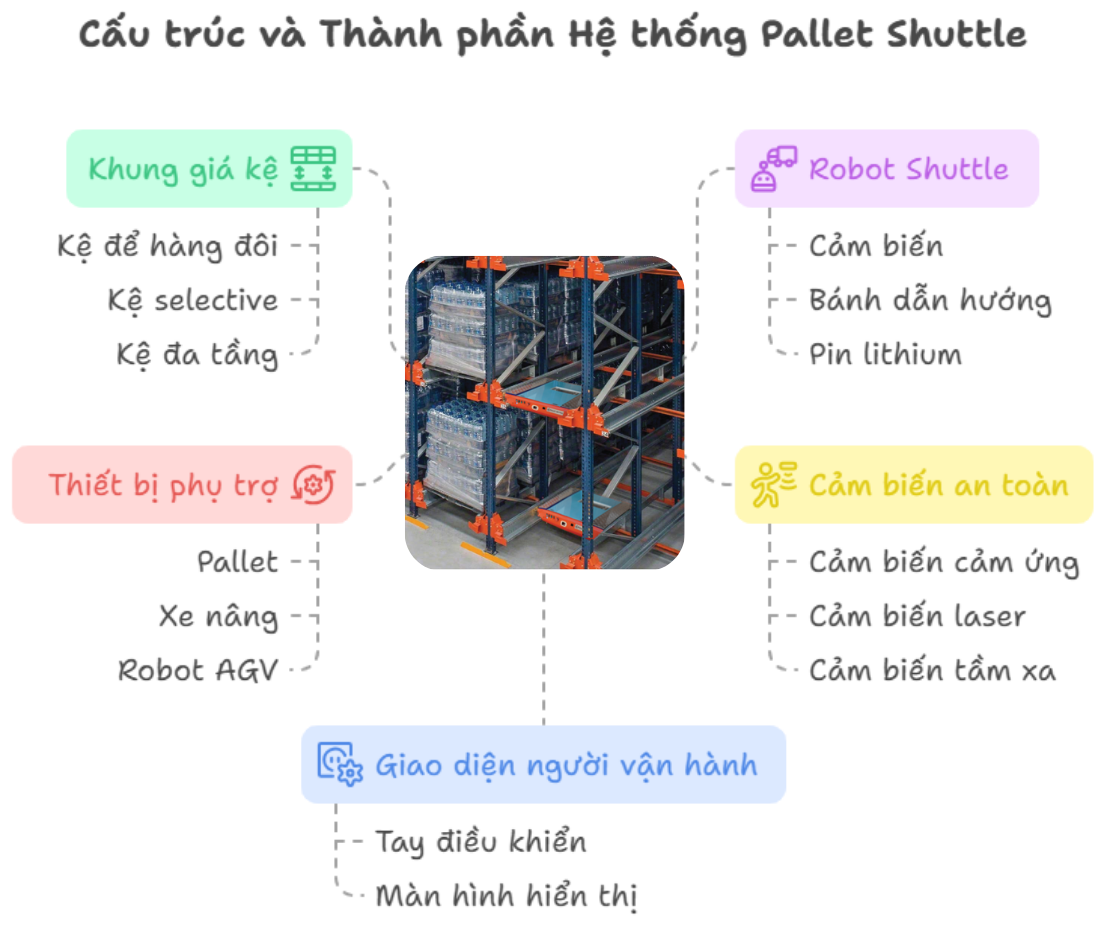
Modern Pallet Shuttle systems consist of many complex yet synchronized components to ensure smooth, safe and efficient operations. From racking frames, shuttle robots, sensors, guidance systems, to control devices, all play an important role in the overall picture of an automated warehouse solution.
In this section, we will go into detail to describe the main components of the system, load-bearing structure, guidance technology, safety sensors and operating interface devices, thereby helping you clearly visualize the basic technical structure and application of this system.
Shelf frame and load bearing structure
The rack frame is the core foundation, determining the load capacity, durability and flexibility of the entire system. Popular types of racks such as double deep racks, selective racks, or multi-level racks are all designed to suit the scale, type of goods, as well as the technical specifications of the products in the warehouse.
The material used to make the shelf frame is usually high-grade steel, solidly processed, anti-oxidation, good load-bearing capacity, suitable for high-density storage activities. The load-bearing structures of the shelves also need to be designed appropriately to work with the shuttle robot system to operate flexibly and safely, minimizing vibration or displacement during continuous operation.
In addition, the system is also equipped with guide rails and a sturdy support structure so that the shuttle can easily move along the length of the shelf, improving accuracy and minimizing damage during continuous operation.
Robot Shuttle and accompanying equipment
The shuttle robot is the soul of the system, helping to perform automatic import, export, and consolidation activities. This device is specially designed, equipped with sensor clusters, guide wheels, and safety sensors to operate accurately in all warehouse conditions.
The accompanying equipment cluster also includes a pallet lifting system, a high-quality lithium battery with large capacity for continuous operation for many hours, along with pallet inspection sensors and safety distance sensors to ensure the movement process does not collide or cause damage.
The shuttle robot structure is also equipped with intelligent control software, which helps optimize routes, avoid collisions and self-program according to real-life situations in daily operations. The integration of these components helps the system operate safely and flexibly in all environments.
Safety sensor and laser guidance system
Safety is paramount in any automated system. Therefore, the Pallet Shuttle system is equipped with a series of inductive sensors, laser sensors and long-range sensors to detect obstacles, determine the exact location, and maintain a safe distance between shuttles and other components in the warehouse.
Special laser sensors play a key role in precise guidance, helping shuttles locate, avoid collisions, and minimize the risk of accidents during operation. This technology also helps shuttles operate smoothly and accurately in tight spaces or environments with many obstacles.
Safety sensors also support emergency stop, error warning or incident detection during operation, thereby improving the safety of equipment, goods and operating personnel.
Controller and operator interface
The control interface is where the operator can easily monitor and control the system’s operation. The controller is equipped with function buttons and an intuitive information display screen, allowing the user to operate manually when necessary or monitor automatically.
Function buttons include import, export, emergency stop, distance adjustment, automatic or manual operation mode selection. The interface can also connect to the central management software via the network to monitor all operations in real time, perform remote adjustment operations.
This system helps to reduce staff training time, improve operational accuracy and ensure that work processes always meet high standards, in line with the requirements of the modern working environment.
Auxiliary equipment: pallets, forklifts, AGV robots
In addition to the main equipment, the Pallet Shuttle Warehouse system also needs auxiliary equipment to ensure continuous and flexible operation. In which, suitable pallets (plastic, wood, steel) play a central role in storing goods.
Forklifts are vehicles that transport goods from outside the warehouse to the warehouse or vice versa, which can be done manually or automatically by AGV (Automated Guided Vehicle) robots. These autonomous robots are capable of transporting goods continuously, minimizing internal transport time, and optimizing overall operations.
The system also integrates supporting equipment such as nitrogen pumps for pallet lifting, goods quality inspection equipment, and cooling or heat preservation systems suitable for specific product types. All of these create a synchronous operating network, providing flexible and optimal operation for modern warehouses.
Advantages of Pallet Shuttle Warehouse System
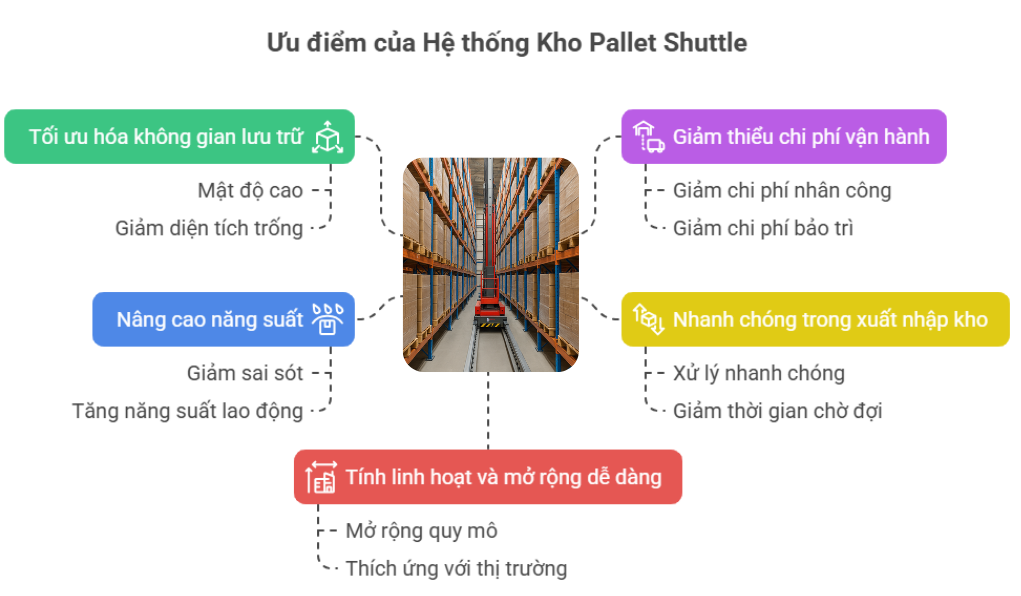
Advantages of Pallet Shuttle Warehouse System
Choosing Pallet Shuttle Warehouse brings many practical benefits, contributing to changing the operational appearance of the warehouse and logistics sector. With the ability to optimize space, reduce operating costs, increase processing speed and improve accuracy, this system is a strategic solution for businesses that want to improve their competitiveness.
In this section, we will explore the outstanding advantages, from the ability to scale, reduce costs to improve work efficiency, thereby helping businesses make reasonable investment decisions in the context of increasingly fierce competition.
Optimized storage space and high density
One of the biggest benefits of Pallet Shuttle Warehouse is the ability to optimize storage space in the warehouse. Thanks to the automatic shuttle system moving in the lanes, pallets can be stacked clearly, concentrated in each lane, helping to reduce unnecessary empty space.
This is extremely useful in warehouses with limited space or in large distribution centers that want to maximize storage capacity without expanding the space. In particular, the ability to automatically stack pallets also helps to minimize the space between pallets, increasing storage density, thereby reducing the cost of renting space or investing in real estate.
In addition, this technology also helps to improve the accuracy of warehouse organization, limit confusion and errors in handling goods. All are aimed at the goal of developing maximum warehouse capacity while maintaining the ability to process quickly and accurately.
Minimize operating and maintenance costs
The automated Pallet Shuttle system significantly reduces labor costs, especially in picking, internal transportation, inventory or assembly operations. Employees no longer have to directly participate in the loading and unloading process, helping to limit the risks of accidents, work accidents or errors.
The maintenance cost of this system has been optimized by the suppliers, using high-quality components that are easy to replace and maintain periodically. The sensor system, laser sensors and intelligent control software help to minimize operating errors, thereby minimizing costs arising from repairs or interruptions in operations.
In the long run, businesses will save a lot of costs on labor, time, energy consumption, and at the same time improve the overall efficiency of the warehouse. This helps businesses be flexible in financial management, focusing on other strategic activities.
Fast in import and export
With the ability to automatically and accurately process each pallet, Pallet Shuttle Warehouse helps to significantly shorten the time of import and export. The continuous operation process, not much dependent on manual factors, helps goods to move back and forth in the warehouse without causing stagnation.
Order processing in FIFO or LIFO mode is flexible, suitable for each type of goods and distribution time requirements. Fast processing speed also helps reduce waiting time in logistics activities, ensuring delivery progress as committed.
This efficiency is especially important in industries such as high-speed food, pharmaceutical or electronics industries, where fast processing times are required to ensure quality and brand reputation.
Improve productivity and reduce errors
The highly automated system helps to minimize errors due to manual operations, while improving warehouse productivity. Activities such as loading, unloading, and palletizing are all performed accurately and automatically, helping businesses achieve high standards of service quality.
The system also helps to easily monitor and analyze data, thereby optimizing processes or making appropriate adjustments to improve efficiency. As a result, labor productivity increases dramatically, and businesses can process larger volumes of goods at the same time.
For example, businesses can increase storage capacity, reduce processing time for unexpected orders, or increase scalability without increasing staff, thereby reducing costs and increasing profits.
Flexibility and easy expansion
The Pallet Shuttle system is designed to be easily expanded, upgraded or adapted to the needs of your growing business. Flexible components such as multiple racks, flexible management software, and the ability to add new shuttles or sensors allow the system to adapt quickly.
Businesses can start small, then expand with additional shelves, shuttles, software, or integrate new technologies such as IoT and AI to improve efficiency. This feature helps businesses save on initial investment costs, while easily adapting to changes in the market and customers.
In addition, the ability to operate in flexible modes such as FIFO or LIFO along with an automatic coordination system makes process control easy, suitable for many different business models in the modern logistics industry.
Disadvantages and challenges when investing in Pallet Shuttle system
Any high-tech solution comes with its own risks and challenges. For Pallet Shuttle Warehouse , limitations in initial investment costs, technology requirements, human resources, installation time or suitable characteristics also need to be carefully considered to ensure long-term investment and operational efficiency.
In this section, we will analyze the limitations in detail, in order to provide an objective view to help businesses better prepare for the digital transformation process in their logistics management.
High initial investment cost
One of the biggest challenges when implementing the Pallet Shuttle System is the high initial investment cost, including hardware, software, installation and staff training. Automatic devices, sensors, and smart management software are all expensive, making many businesses hesitant when deciding to innovate technology.
However, it should be recognized that this investment is long-term, helping to minimize operating costs, labor, maintenance and errors. Businesses should carefully consider their financial capacity, choose systems that are suitable for their scale and development strategy to optimize benefits.
Additionally, financing, leasing, or partial conversions can be considered to reduce the initial financial pressure. This will make the transition to automated warehouses more feasible in today’s fiercely competitive environment.
Depends on technology and management software
Pallet Shuttle systems require automated software, precision guidance and sensor technology to operate, and therefore, the risks associated with technology dependency are unavoidable. Software failures, sensor failures or control system failures can disrupt operations, impacting the efficiency and reputation of the business.
In addition, maintenance, updating of new software and technology requires continuous investment, requiring highly qualified human resources or the ability to hire services from professional suppliers. Therefore, businesses need to prepare carefully in terms of technology, human resources and backup strategies to minimize risks.
Professional staff training required
Because the automated system is complex, operators need to be properly trained in how to use, troubleshoot, maintain and upgrade the equipment. Not everyone can take on this job due to the requirements of technological knowledge and skills in operating automated equipment.
This requires businesses to invest in training their staff, or recruit appropriately qualified staff, which will entail costs and preparation time. In addition, the training process also needs to be continuous to update new technology and maintain operational efficiency.
Conformance to standard product type
Currently, the Pallet Shuttle System is mainly suitable for standard goods, with few special requirements regarding size, weight or properties of goods. Therefore, products with special characteristics, such as fragile goods, extra heavy goods or goods with irregular shapes, may not be suitable for optimal operation on this system.
This sets a limit for businesses that want to apply this automated system to a wide range or variety of products. To overcome this, it is necessary to research and integrate quality control technologies, suitable pallet types or specialized shelf designs suitable for each type of goods to maximize benefits.
Long deployment time and complex installation process
The installation of the Pallet Shuttle system cannot be done in a short time, due to the high precision requirements in configuration, shelf design, software integration and operational testing. In particular, the movement and installation of sensors and automatic equipment all require careful preparation time.
In addition, the process of training employees, testing the system, and calibrating technology also contributes to the long implementation time, causing temporary disruptions to warehouse operations. This requires businesses to have appropriate contingency plans and consider the installation time so as not to greatly affect daily production activities.
This investment of time and effort will be worth it if the system operates stably and brings long-term benefits, however, businesses need to carefully consider the related factors to avoid incurring costs or losses during the transition process.
Practical applications and areas of use of Pallet Shuttle Warehouse

Pallet Shuttle systems have been widely applied in many fields, bringing outstanding benefits in terms of productivity, accuracy and space optimization. In particular, industries such as logistics, retail, and manufacturing can take advantage of the power of automation technology to improve the efficiency of their warehouse operations.
In this section, we will review the typical areas and how this system has, is and can continue to support businesses to optimize their logistics operations, in accordance with the specific requirements of each industry.
Fast moving consumer goods warehouse and supermarket
One of the most common applications of Pallet Shuttle is in supermarket warehouses and fast-moving consumer goods (FMCG) distribution centers. This requires fast and accurate loading and unloading speed, retrieval to ensure continuous supply and timely response to customer needs.
The automated system helps optimize storage space, reduce staff operating time, thereby improving product handling productivity, minimizing the risk of damage or loss of goods during storage. Supermarkets and distributors can easily track inventory, perform FIFO procedures to ensure product freshness.
In addition, the system also helps businesses manage the volume of goods in cycles, reduce errors or problems during loading and unloading, thereby improving customer experience and maintaining profits.
Cold storage and special environment
Cold storage, food storage, pharmaceuticals or goods requiring environmental control are major challenges for automated systems. However, technological improvements have allowed Pallet Shuttle systems to operate effectively in low temperature, high humidity or special gas environments.
The system is designed to withstand harsh conditions, strict hygiene regimes and corrosion resistance of components. Automation helps to minimize direct contact of employees with goods in hazardous environments, ensuring labor safety.
Not only does it improve storage efficiency, the system also helps maintain the freshness of goods, reducing waste due to operational errors or long storage times. This is the optimal solution for businesses in the food and pharmaceutical industries with high requirements for quality control.
Integrated manufacturing and logistics
The strength of the Pallet Shuttle System is its ability to be integrated into manufacturing plant models, distribution centers or integrated logistics systems. In factories, the system helps optimize the process of transferring raw materials from the warehouse to the production line, while facilitating the import and export of goods.
Manufacturing companies can track inventory accurately, reduce lead times, and increase flexibility in coordinating internal transportation or distribution to the market. The system also helps reduce the risk of errors, improve accuracy in transportation, and control quality.
In addition, innovative factories can take advantage of automated management software, making optimal decisions about inventory and raw material reserves, thereby improving competitiveness and the ability to respond quickly to the market.
Heavy duty storage and various sizes
One of the challenges of applying automated technology is the ability to handle heavy, large or irregular sized items. However, today’s Pallet Shuttle systems have been improved to suit these requirements, with high load capacity, solid structure and flexibility in racking design.
This opens up opportunities for businesses operating warehouses for heavy goods such as industrial equipment, large machine parts or goods with non-standard dimensions. The system helps reduce labor during transportation and storage, while keeping the process of controlling and tracking goods easier and more accurate.
This contributes to improving space efficiency, minimizing errors and increasing safety in operating this type of warehouse, suitable for heavy industry, construction or large industrial equipment manufacturing.
Small and medium enterprises move towards smart warehouse model
In the context of the development trend of Industry 4.0, many small and medium enterprises are gradually moving towards building smart warehouses and automating processes to compete effectively. The Pallet Shuttle system is the right solution to help these enterprises optimize storage space, reduce labor costs and easily expand their operating model.
With just the right initial investment, businesses can take advantage of automated warehouse management software, combined with IoT solutions for online tracking, thereby optimizing operational processes. This not only saves time and increases productivity, but also enhances competitiveness and meets customer requirements more flexibly.
This form also helps small businesses easily expand their operations in the future, integrating new technologies such as AI, autonomous robots or smart sensors to improve operational efficiency in a sustainable way.
Conclude
The Pallet Shuttle Warehouse System is a major step forward in modern warehousing, helping businesses improve efficiency, optimize storage space and reduce operating costs. From applications in logistics, retail, manufacturing to cold storage or for small and medium-sized enterprises, this system has proven its ability to bring clear benefits.
Despite the limitations of cost, technical requirements and suitability for each type of goods, the benefits of productivity, accuracy and flexibility have promoted the trend of investing in warehouse automation technology. Businesses need to carefully consider these factors to choose the right solution, and be ready to invest in long-term development to improve competitiveness and expand the market.
In the context of increasingly fierce competition in the logistics and warehousing industry, applying the Pallet Shuttle system is a smart strategy for businesses to maintain their competitive position, improve service quality and develop sustainably in the future.