In the era of technology 4.0, businesses are constantly looking for optimal solutions to improve productivity and reduce operating costs. AS/RS automated warehouses have become one of the key technologies, helping to automate the entire process of storing and retrieving goods accurately, quickly and safely. The application of AS/RS automated warehouses not only brings benefits in terms of operational efficiency but also opens up opportunities to expand production scale, optimize space and minimize risks in warehouse operations.
What is an AS/RS automated warehouse?

The essence of an AS/RS automated warehouse is an integrated system of automated equipment to optimize the process of storing, retrieving goods and managing warehouse data. Instead of relying on workers to perform manual operations, this system operates based on sensors, sensors, robots and management software to ensure accuracy, speed and safety. The components in the system are closely linked, forming a continuous, uninterrupted cycle of goods processing.
AS/RS typically includes equipment such as automated shelves, loading and unloading robots, conveyors, sensors and control software, allowing the system to operate continuously 24/7. Thanks to that, businesses can process large numbers of orders, reduce processing time, and improve the accuracy of warehouse data. This concept has become the new standard for modern warehouse systems, especially in the manufacturing, logistics and retail industries.
Outstanding advantages of AS/RS automated warehouse

Choosing an AS/RS automated warehouse system brings many benefits not only in terms of operation but also in terms of long-term business development strategy. These advantages help businesses maintain high competitiveness in an increasingly fierce market.
Increase productivity and reduce retrieval time
The automation system eliminates time-consuming manual operations and optimizes the processing of goods in order of priority. Forklifts, robots and management software work in sync, ensuring that goods are picked up at the right time, in the right quantity and with the right accuracy. This significantly reduces the time to complete each order, improving overall productivity.
In addition, faster operations also help businesses process large volumes of orders, promptly meeting market demand. The system’s ability to independently and autonomously track goods also helps limit disruptions in production operations and provide better customer service.
Save labor and operating costs
By automating most operations such as picking, shipping, and checking, businesses can reduce the number of direct employees in the warehouse. The cost of salaries, insurance, and employee training is also significantly reduced.
In addition, the automated system helps to minimize errors caused by manual operations, thereby reducing repair costs, errors in inventory management and order processing. At the same time, it minimizes the risk of occupational accidents, helping businesses save on insurance costs and maintain a safer working environment.
Improve accuracy in inventory management
Accuracy in diverse warehouse data is always a challenge for many businesses. However, AS/RS automated warehouses are equipped with sensors and data analysis software to help track the exact location of items, synchronized with the business management system.
This helps minimize errors in recording inventory quantities, helping businesses predict demand and plan production accordingly. High accuracy also avoids the risk of excess or shortage inventory, thereby optimizing cash flow and reducing inventory.
Ensure occupational safety and minimize accident risks
Automation minimizes human intervention in dangerous activities such as picking and transporting goods in warehouses. Robotic and sensor systems ensure safe operation, limit work accidents, and contribute to a healthy and professional working environment.
Minimizing manual operations also helps employees focus on controlling, monitoring and improving processes, minimizing risks related to technical errors or accidents causing injuries.
Optimize storage space and scalability
With the optimal design of automatic warehouse shelves, the ability to utilize warehouse space is significantly increased compared to traditional storage methods. The system can store goods vertically, minimizing empty space, expanding storage capacity in the same available area.
In addition, this system is flexible, easy to expand or adjust according to the development of the business. The autonomous devices can integrate new modules or upgrade the software to suit the needs of increasing scale, helping businesses not be limited by space or the ability to handle goods.
| Criteria | Specific benefits | Impact on business operations |
| Increase productivity | Faster, more accurate processing | Improve competitiveness, serve customers better |
| Cost savings | Reduce labor, limit errors | Reduce operating costs, optimize financial resources |
| Data accuracy | Accurate inventory management, better forecasting | Avoid excess or shortage inventory, improve operational efficiency |
| Safe | Reduce accidents, increase healthy working environment | Increase stability, reduce legal and insurance risks |
| Storage space | Optimized space, easy to expand | Increase storage capacity, suitable for long-term development needs |
Main components of AS/RS warehouse system

The cooperation between the components of the AS/RS system not only ensures synchronization but also optimizes operational efficiency. Below are the most important components of the system.
Automatic warehouse shelves and space-optimized design
Automatic warehouse shelves act as the foundation of the system, determining the storage and retrieval capacity of the entire warehouse. These shelves are designed based on the latest technology, optimizing space, having high stacking ability, suitable for small spaces.
Choosing the right shelving style and configuration is key to ensuring a smooth operation. They can be structured in grids, stacked or tiered configurations to suit specific types of goods and spaces. In addition, the shelves are equipped with sensors to monitor the status of goods, avoiding wasted space or collisions due to manual operations.
Automated forklift and cargo handling function
The automated forklifts in the AS/RS system are pre-programmed to move precisely between shelves, picking or placing orders as required without direct human intervention. These vehicles are compact in structure, equipped with sensors, cameras and GPS to operate precisely in the warehouse environment.
Unlike traditional forklifts, automated forklifts can operate on a fixed schedule or according to management software commands. This helps reduce travel time, ensuring that goods are picked up in the correct order and in the shortest time. Synchronization between automated forklifts also helps limit collisions, optimizing operations in warehouses with limited space.
Conveyor system and goods position conversion
Conveyors are automated material handling systems that ensure the movement of goods between areas such as receiving, packing, checking or shipping. This system is often combined with automated loading and unloading robots to handle goods continuously, minimizing waiting time and manual operations.
In addition, the conveyor system also helps to coordinate goods in order of priority, minimize errors and improve productivity. The structure of the conveyor is flexible, and can adjust the length, speed and direction to suit each type of goods or warehouse model.
Warehouse management software and control devices
Warehouse management software (WMS) is the central control point of the entire system. The software’s function is not only to track the location of goods but also to predict inventory, plan movements and optimize workflows.
Control devices such as sensors, sensors, GPS devices, and optical sensors all work together with software to provide accurate data, allowing the system to respond quickly and accurately to operating commands. The integration of IoT and AI technology also helps the system learn and optimize operations over time.
Types of AS/RS Automated Warehouses

Classification based on type of goods: pallets and boxes
Goods in the warehouse can be classified by unit load such as pallets or boxes, each of which is suited to separate AS/RS systems to optimize efficiency.
Pallet systems and suitable racks
Pallet AS/RS systems are designed to accommodate large, bulky items or goods that require stability during transportation and storage. Pallet racks are designed in standard sizes, and can include automatic stacking modules or efficient rail-based forklift systems.
These systems are optimal in industries such as food processing, electronic components, or industries that require managing large quantities of inventory with little change in items.
Box storage system and height adjustment feature
Automatic storage box systems are often compact in design, with adjustable shelf heights to suit each type of box, enhancing flexibility and optimizing space. Often used in the pharmaceutical industry, electronic components, or industries that require environmental standards such as cold storage, high temperature controlled warehouses.
These systems are particularly suitable for warehouses that store a variety of box-type items, requiring fast, accurate retrieval of each specific item.
Classification by storage density
Storage density greatly affects the ability to optimize warehouse space and operational efficiency. AS/RS systems can be divided into types suitable for each space condition and number of SKUs.
Direct access AS/RS systems: single and double deep
In a direct access system, pallets or goods are located in separate deep aisles, making it easy to retrieve goods without having to move other pallets. Single deep is suitable for businesses with many SKUs but few of each type, while double deep optimizes space in limited aisle conditions.
Compact system suitable for few SKUs and many pallets
This system is optimally designed for warehouses with limited space or containing many items, many SKUs, and goods that are frequently removed and replaced. Suitable for retail businesses, e-commerce or warehouses storing pharmaceuticals and components.
Classification by operating method
The way a system operates determines the automation, performance, and scalability of the entire system.
Pallet Shuttle System and Space Maximization Benefits
The Pallet Shuttle system focuses on dense storage capacity, automatic operation, suitable for businesses with large quantities of goods, needing to maximize space. Pallets are stacked close together, the system automatically places or retrieves goods through self-propelled Shuttles, helping to increase storage many times over.
Classification by level of automation: semi-automatic and fully automatic
Semi-automatic systems are suitable for businesses that are just starting digital transformation and still need some manual support. Meanwhile, fully automatic systems operate self-programmed, do not require direct human intervention, and are suitable for large-scale, high-speed requirements.
Robotic Applications in AS/RS Warehouses and Autonomous Devices
In addition to self-propelled forklifts, collaborative robots, AGVs, loading and unloading robots, and smart conveyors are all integrated to maximize automation, improve efficiency, reduce errors, and reduce labor costs.
AS/RS standards and automation levels
Applying international standards for safety, performance, and scalability, businesses can easily choose the right system, ensuring operations always meet the highest quality standards.
Semi-automatic warehouse: features and applications
This category is suitable for businesses that want to minimize initial costs and are not too large in scale. Semi-automatic transfer vehicles operate based on control commands, suitable for warehouses with average volume of goods and not too complicated handling operations.
Fully automated warehouse: technology and benefits
The system is fully automated and operates using cutting-edge software, integrating AI and IoT, without the need for direct human intervention. This helps improve speed and accuracy, while minimizing operational risks, making it suitable for large businesses with high efficiency and safety requirements.
Remote control solutions and WMS warehouse management system integration
These systems allow remote monitoring and control via software, helping to better manage, detect errors quickly and optimize operating processes. WMS integration also optimizes inventory, real-time order processing, and minimizes errors.
Application of robot systems in warehouse automation
Robots such as cobots, AGVs, and loading and unloading robots have become an indispensable part of AS/RS automated warehouse systems , helping to improve efficiency and minimize human risks, while enhancing the ability to adapt to the specific needs of each business sector.
AS/RS system by operating temperature
In industries that require environmental control such as cold storage, food preservation, and pharmaceuticals, choosing the right system also depends on the operating temperature environment of the automated system in the warehouse.
Benefits of working in a temperature controlled warehouse environment
Maintaining a stable temperature helps protect inventory quality, minimizing damage caused by environmental changes such as humidity, high or low temperatures for a long time. As a result, goods are best preserved, maintaining their value and quality.
Applications in cold storage and specific industries
AS/RS systems are suitable for cold storage in the food, pharmaceutical, and specialized electronic components industries in high-tech manufacturing. These systems need to be specially designed to withstand low temperatures, have anti-ice and anti-rust standards, and operate continuously in harsh environments.
Factors to consider when building a storage system in a temperature controlled environment
- Equipment durability in low temperature conditions
- Integrated cooling and heating system suitable
- Materials, surface coatings suitable for rust prevention
- Regular maintenance to ensure continued correct operation
Practical applications of AS/RS systems in industries

AS/RS automated warehouse systems have proven their practical value through diverse applications in many industries, contributing to improving operational performance, reducing costs and quickly responding to market needs.
Manufacturing industry: storage of raw materials and finished products
In production, the system helps organize according to the FIFO, FEFO principles, or according to specific requirements, helping to control inventory well, minimize waste and improve production process productivity.
Logistics and distribution: optimizing warehouse processes
With fast, accurate and automatic retrieval capabilities, AS/RS systems help distribution centers operate efficiently, reduce order processing time, maximize storage space and improve accuracy in product classification.
Retail and e-commerce: fast inventory management
In the retail sector, especially e-commerce, where order processing speed determines success, automated systems help businesses manage a variety of SKUs in multiple warehouses, ensuring orders are processed accurately and quickly.
Pharmaceutical industry, electronic components and high-tech products
Requiring precision in each specific item in the warehouse, the automated system helps manage items with specific properties, maintaining their original properties and quickly diagnosing errors when problems occur.
Food processing plant and cold storage
The system operates in a temperature-controlled environment to ensure food quality, protect newly harvested or processed goods, and meet food safety and hygiene standards for functional foods.
Criteria for choosing the right AS/RS system for your business
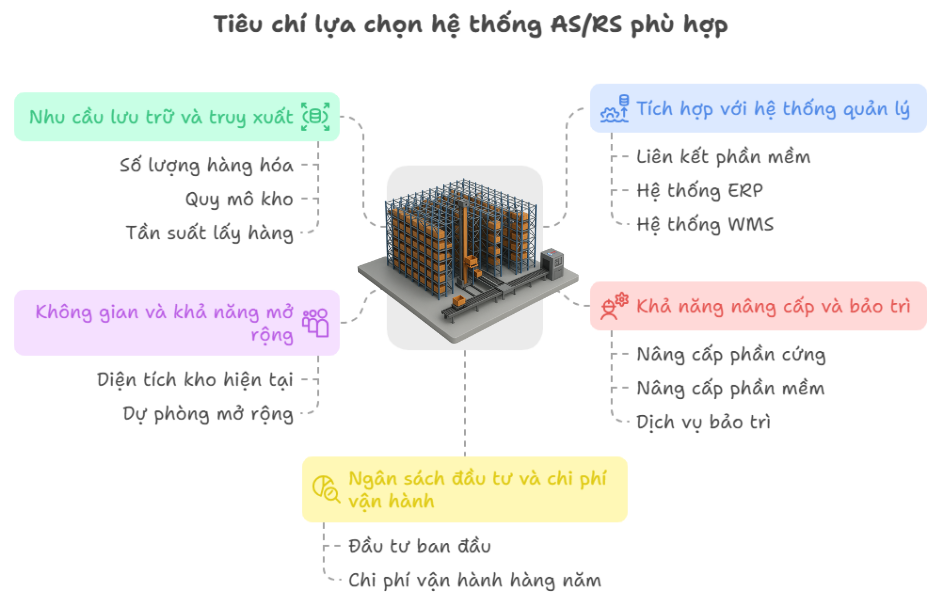
Not only relying on basic features, businesses need to consider appropriate criteria to choose the right system, thereby optimizing investment efficiency.
Determine storage needs and access levels
The most important thing is to clearly understand the business’s need for quantity of goods, warehouse size, and frequency of picking to choose the right system, ensuring no waste or frustration in operations.
Clear on space and expandability
Determining current warehouse space and future expansion reserves helps to choose the right system, with flexibility in upgrading or adjusting the design to suit long-term development needs.
Consider investment budget and operating costs
Initial investment and annual operating costs greatly influence the decision. Semi-automated solutions are suitable for businesses with limited budgets, while highly automated systems are suitable for businesses looking for a long-term investment.
Consider integrating with existing management systems
The ability to link software, ERP systems, and WMS to optimize processing, inventory, and production planning is a key factor in the success of a comprehensive automation solution.
Assessment of long-term upgradeability and maintainability
The system should have the ability to upgrade hardware and software to suit expansion needs, along with maintenance services and technical support from the supplier to help maintain long-term stable operation.
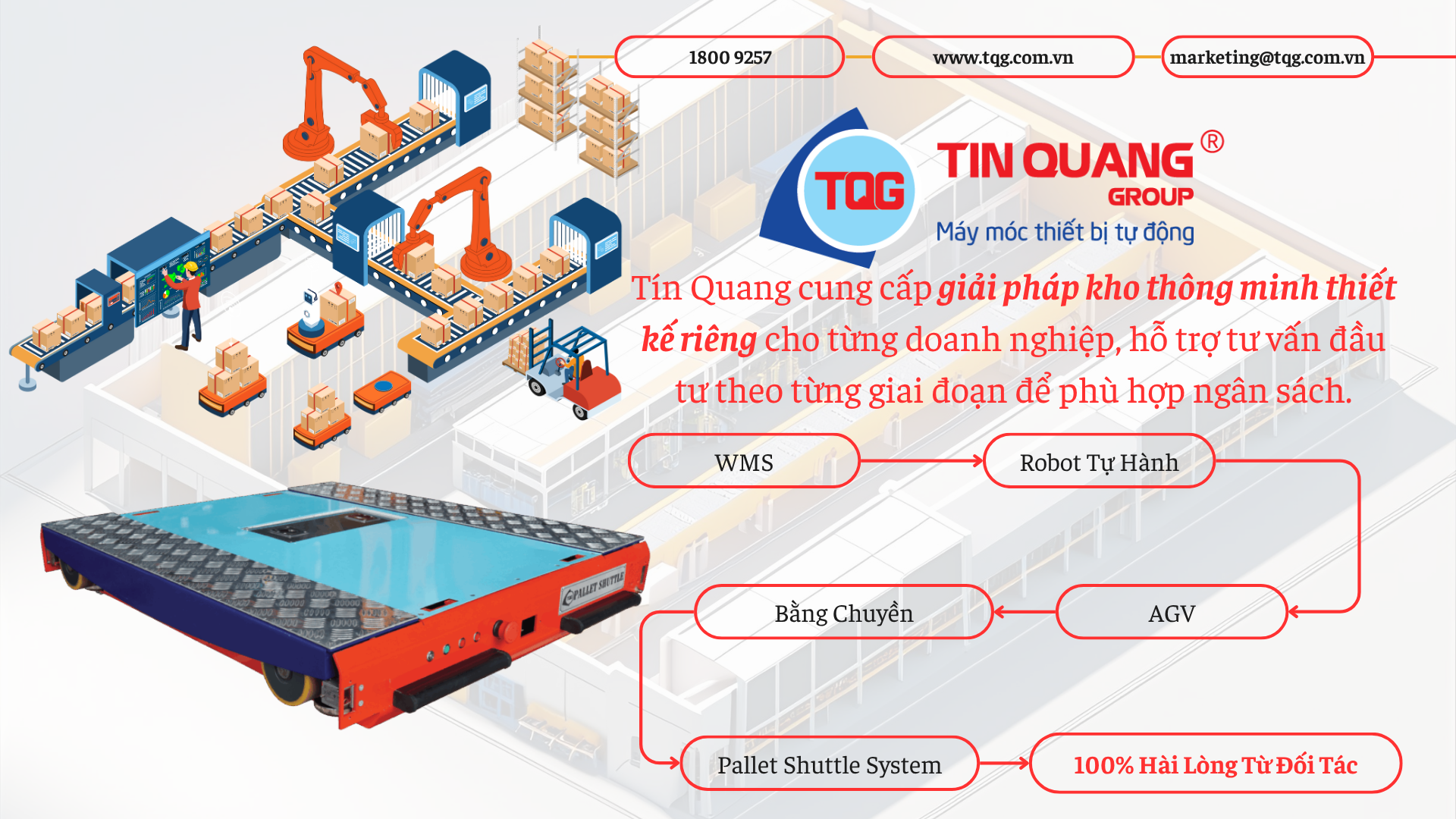
Tin Quang Group – The leading unit specializing in designing and constructing automated pallet shuttle warehouses in Vietnam
Conclude
The AS/RS automated warehouse system is the key to helping businesses improve the efficiency of their warehouse operations in the 4.0 era. With the ability to highly automate, optimize space, minimize costs, improve accuracy and protect employees, this system is suitable for a variety of industries and business sizes. Choosing the right one based on specific needs, space, budget and scalability will be the decisive step for businesses to develop sustainably and compete more effectively in an increasingly volatile market. Investing properly and using the right system is the key to helping businesses overcome all challenges and reach further in the modern digital era.